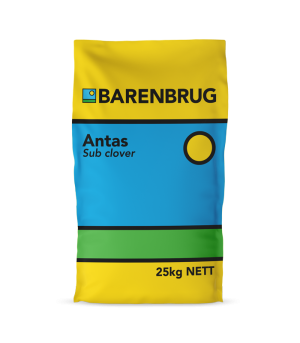
Antas
Suited to either permanent pasture or medium term cropping rotations.
-
One of the highest dry matter producing Sub clovers available
-
Persists well in various soil types
-
Strong growth through autumn and winter
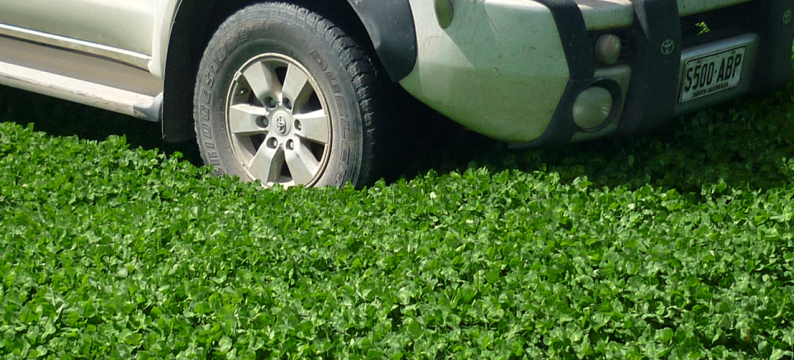
Antas demonstrates a prostrate to semi erect growth habit and persists well on various soil types. It has mid to late season maturity and is suited to medium to high rainfall environments, with a growing season of 7 months. These attributes combine to make Antas suited to either permanent pasture or medium term cropping rotations. Antas will also provide the benefits of soil nitrogen as well as providing an effective disease break.
Key Features
- Brachycalycinum sub clover with mid late season maturity – 134 days to flowering (Perth)
- Exceptionally vigorous establishment
- Antas is one of the highest dry matter producing Sub Clovers available
- Antas has extremely strong growth through autumn & winter
- The mid-late maturity of Antas ensures high production through the season
- High level of hard seed
- Has very large leaves offering good grazing and hay production
Benefits of sowing Antas
- Antas produces very high levels of forage, much higher than traditional cultivars
- Amazing seedling vigour and winter growth gives Antas excellent production throughout the year and makes it an ideal choice for grazing
- Antas produces very large leaves which makes it attractive to stock and also provides improved levels of digestibility
Breeding
Antas is a black seeded Sub clover, belonging to the Trifolium subterranean ssp. brachycalycinum family. It was derived from elite Sardinian germplasm and therefore is well-suited to Mediterranean and temperate climates.
Developed as a superior alternative to Clare with improved hard seed levels and excellent herbage production.
- Agronomy and Management
Antas has demonstrated excellent winter and late season productivity.
It produces very large leaves that makes it attractive to stock and provides improved levels of digestibility.
Care must be taken with new sown pastures so as not to overgraze too early, as plants can be pulled from the ground.
Light grazing during the establishment period will help control weeds and encourage dense prostrate growth.
Once established, heavy grazing of Antas up to flowering will improve seed set.
One weakness of Antas is that it exhibits poor seed burial, which can result in high levels of seed removed during hay production/late grazing.
Pest Resistance
Antas, as with all Sub Clovers, is susceptible to Red Legged Earth Mites (Halotydeus destructor), Blue-Green Aphids (Acyrthosiphon kondoi), Blue Oat Mites (Penthaleus major) and Spotted Alfalfa Aphids (Therioaphis trifolii). Control is essential at the early seedling stage and appropriate pest management must be implemented as required.
Disease Resistance / Tolerance
Antas has demonstrated moderate resistance to Pythium (Pythium spp.) and Fusarium (Fusarium spp.). It has proven to be slightly susceptible to Clover Scorch (Kabatiella caulivora).
Specifications
| Name | Value |
|---|---|
| Rainfall requirement (min) | 500mm-750mm+ |
| pH | 4.8-8.0 |
| Soil type | Most soil types |

Antas