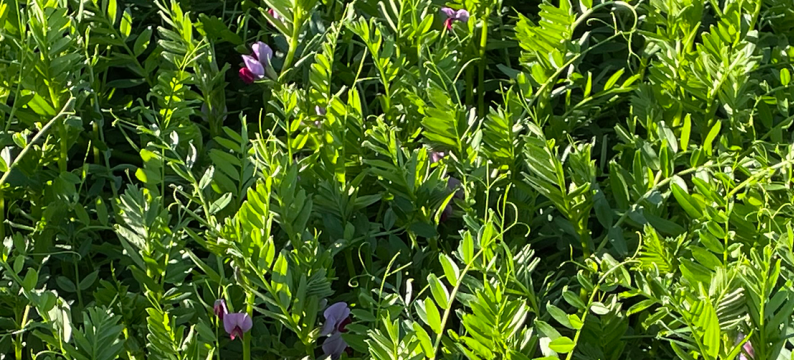
Volga
Bred as a high yielding variety for low and mid rainfall areas.
-
Very good early establishment
-
Suited to shorter season areas
-
High yielding, highly rust resistant
Volga was bred as a high yielding variety for low and mid rainfall areas.
It is particularly suited to shorter season areas where the growing season finishes sharply. Volga has good initial establishment, is rust resistant, and earlier flowering and maturing than Blanchefleur and Rasina. Vetch flowering and maturity is ‘parallel’ with development of nodules for nitrogen fixation. Earlier maturing equates to earlier nodule development.
Key Features
- Earlier in maturity by 7-12 days than Rasina (from seeding to full flowering 90-100 days)
- Soft seeded
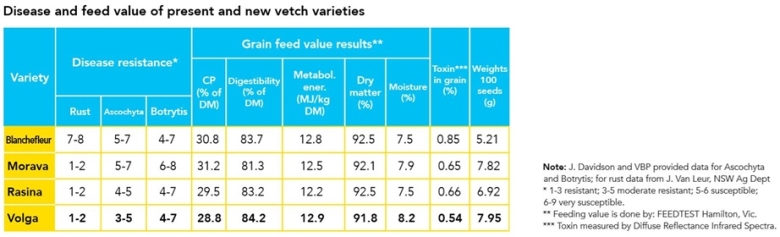
- Moderately resistant to ascochyta blight
- Higher yielding in both grain and hay than current varieties in <380mm rainfall
Benefits of sowing Volga
- High yielding, highly rust resistant common vetch variety
- Very good early establishment
- Improve the economic return in crop rotations in low to mid rainfall areas
- Less volunteer plants in following year due to soft seedness
- Nitrogen fixation improves soil fertility for following years crop
Performance
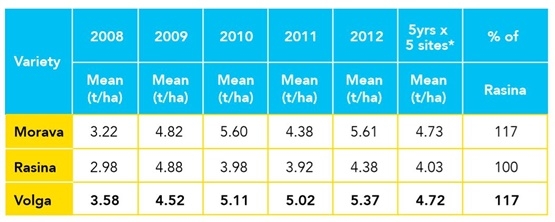
Volga has high grain and herbage yields and is well adapted to shorter season areas as well as similar areas to where Rasina vetch is currently grown. Volga has bigger seeds and also improved digestibility than Rasina.
2008-2012 Long-term dry matter production of vetch varieties (5 sites* x 5 yrs).
Yield expressed as % of rasina’s yield
- Management and Agronomy
Paddock selection and basic requirements for growing Volga are similar to other common vetch varieties.
Good control of weeds in early growth stages is very crucial, as vetches are poor competitors to weeds in early growth stages, but when vetch has 15 nodes it is competitive with broadleaf and grassy weeds.
For harvesting grain/seed, dry matter, grazing and green manure there are no differences between Volga and other common vetch varieties.
For hay/silage, cut when there are 50% flowers and 50% small pods for the best combination of yield and feeding value.
For green manure, turn into soil or desiccate at flowering time.
Frost tolerance testing was conducted in Serbia for two years.
Frost occurred for five consecutive days at -10˚C resulting in the following seedling survival rates: Volga 85%, Timok 82%, Morava 66% and Rasina 72%.
Volga was not sensitive to any herbicides recommended/registered for use in common vetch and applied according to label directions.
Volga grain as with other common vetch types can be used as a part of a feed ration with stock.
Establishment
The recommended planting rate for Volga is: 30 – 40kg per hectare. Volga’s early flowering/maturity provides increased flexibility when compared to other varieties in relation to sowing time. Sowing rates are related to the end use targeted and rainfall areas. Higher rates are required for hay/silage, grazing and green manure and lower rates are used for grain/seed production.Disease/Pest Resistance
Volga is susceptible in early growth stages to red-legged earth mite and lucerne flea, like other common vetch varieties. Also, Volga is susceptible to bluegreen and cowpea aphids from early growth through to pod maturity, as well as to native budworm during pod formation and filling.
Specifications
| Name | Value |
|---|---|
| Rainfall requirement (min) | 330mm-380mm |
| pH | 5.0-8.0 |

Volga