
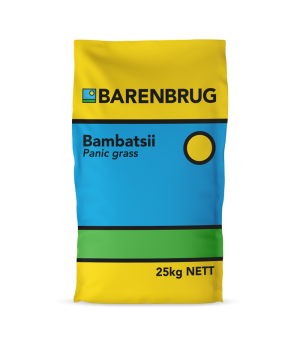
Bambatsii
A summer growing perennial best suited to the higher fertility, self mulching, clay soils.
-
High yielding and palatable perennial grass
-
Tolerates saline soils, waterlogging, drought conditions
-
Distinctive bluish leaves with prominent white mid rib
Bambatsi is a summer growing perennial best suited to the higher fertility self mulshing clay soils. It will withstand waterlogged conditions for a period of time. Bambatsi has good salt tolerance, better than Rhodes grass. Bambatsi is drought tolerant, has poor winter growth and is quick in the spring for early feed. Generally an erect, leafy grass with tussocks spreading by short underground stems (rhizomes) to over 90 cm in diameter. Bambatsi is leafy to about 1m and growing to over 1.5m at flowering. It is distinguished by its distinctly bluish leaves with prominent white mid-rib.
Key Features
- High yielding and palatable perennial grass
- Distinctive bluish leaves with prominent white mid rib
- Tolerates saline soils, waterlogging, drought conditions and has some tolerance to frost
- Also tolerates heavy black clays and melon hole country
Establishment
Establishment is slow with seedlings taking several months to establish and it is recommended that the stand be allowed to seed in the first year before grazing commences. In warmer environments, early or late wet season sowing is therefore preferred, to avoid competition from vigorous mid-season weed growth. In cooler subtropical environments where early sowings may encounter competition from spring weeds, it is best to sow when there is the greatest probability of experiencing several consecutive days of rainy weather.
- Agronomy and Management
Bambatsi panic is slow to establish, and in dense, establishing stands of grass mixtures, early grazing is advised to reduce the competition. However, while mature stands withstand short-term heavy grazing, Bambatsi should be grazed only lightly during the establishment year. Very palatable when young, declining with maturity. Being so palatable, it is selectively grazed if sown with purple pigeon grass. Continual overgrazing will destroy the stand as it is an erect tussocky grass and must be allowed to recover its plant reserves. Its tussocky habit allows companion legumes (e.g. Medic) to grow successfully for a balanced pasture. Performance DM yields of 8–23 t/ha (commonly 10 t/ha) have been recorded, depending on rainfall and soil fertility. In a grazing trial, Bambatsi Panic/lucerne pastures persisted better and produced more dry matter and sheep liveweight than Rhodes grass/lucerne pastures in dry conditions on the Darling Downs, Queensland. High quality feed; crude protein levels of 19% when young and leafy decline to 5% when mature; digestibility of about 60% in leafy, 3–6 week old regrowth, with % crude protein declining to 12–15% and digestibility to 47% after 10 weeks regrowth; at these levels, the capacity for liveweight gain declines dramatically. Mature, hayed-off dry matter is of a very low quality.
Animal Production
Toxicity: Photosensitization has occurred in sheep, goats, cattle and horses grazing on Bambatsi pastures, but the condition is rare. Saponins in the grass are assumed to be the cause of the formation of crystalloid substances in the biliary system that subsequently obstruct the bile duct and cause secondary photosensitization. Deaths due to liver failure have been encountered. Sheep appear to be more vulnerable to this condition, which is mostly brought on under hot humid conditions, than are cattle. Sheep, particularly lambs, in stressed condition as after shearing or transport, are the most susceptible, particularly if placed on early regrowth following a dry period.
Pest / Disease Resistance
No significant pests or diseases. Recorded as being susceptible to maize streak monogeminivirus. A new species of cyst nematode, Heterodera goldeni, has been identified on Panicum coloratum in Egypt.
Specifications
| Name | Value |
|---|---|
| pH | 5.5-8.0 |
| Soil type | Clay loams |
| Treatment | AgriCote or bare |
| Sowing rates | Marginal dryland: 3 – 5kg per hectare |
| Sowing rates | Good dryland: 8 – 12kg per hectare |
| Sowing rates | Irrigated: 12 – 15kg per hectare |
| Rainfall requirement (min) | 450mm |

Bambatsii