
Herbicide Tolerance in Medics
Medics provide a valuable and reliable high quality pasture option, especially in lower rainfall situations where other pasture legume options may struggle or otherwise fail.
The recent development of SU herbicide tolerant varieties offers further system flexibility and resilience.
Medics are well suited to semi-arid agricultural zones, and are used to provide high quality feed for livestock. They also improve soil fertility through nitrogen fixation and act as a disease break for various cereal root pathogens, or may be utilised as a grass-free pasture for integrated weed management.
These self-regenerating pasture species have relatively high levels of hard seeds which enables them to persist through cropping phases and regenerate in subsequent years as pasture.
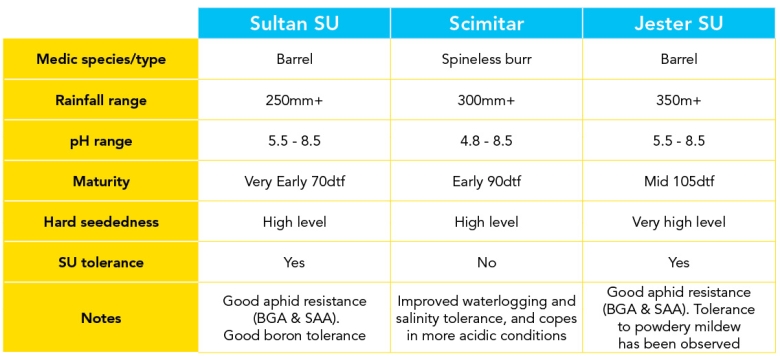
SU Herbicide Tolerant Medics
In recent years, Barenbrug has released medic varieties that have tolerance to residual SU (Group 2 sulfonylurea) herbicides. SU medics have been tested to ascertain their tolerance to residues of commonly used SU herbicides in a fashion that mirrors the use pattern of the herbicide option.
SU herbicides are not registered or recommended for post-emergence use in SU-tolerant medic pastures.
SU Herbicide Tolerance Levels
SU medics have been tested to demonstrate tolerance to sulfonyl-urea herbicide soil residues that are typically encountered after use in a prior crop management. The following levels of SU tolerance have been demonstrated:
Chlorsulfuron:
Soil residue level tested:1.5g a.i./ha
Equivalent scenario:
• chlorsulfuron 750 applied at 15g/ha to prior crop >6 months ago
• 11.25g a.i./ha applied
• soil pH<7, chlorsufuron half-life of 2 months
• soil residue expected to be about 1.4g a.i./ha
Triasulfuron:
Soil residue level tested: 26g a.i./ha
Equivalent scenario:
• Triasulfuron 750 applied at 35g/ha to prior crop 12 months prior.
• Soil pH 8.3, 275mm rainfall between application and medic sowing.
• Soil residue expected to be minimally reduced, and otherwise unsafe for standard medics or clovers for 2-4 years.
Metsulfuron:
Soil residue level tested: 4.2g a.i./ha
Equivalent scenario:
• Metsulfuron 600 applied at 7g/ha in summer fallow spray (Feb)
• SU medic sown 3 months later (May)
• Minimal rainfall or opportunity for residue breakdown
• Non-SU tolerance medic yield decreased by >80%
Under these scenarios, there appears minimal or no reduction on plant DM or seed yield for SU tolerant medics.
These has been no measurable impact on medic rhizobia activity associated with SU herbicide residues tested.
Other broad-leaved herbicide options for use in medics
SU tolerant medics may also be treated with typical herbicides registered for use in medic pastures. Examples include: 2,4-DB, bromoxynil, flumetsulam, imazamox, and pyraflufen-ethyl.
Options for controlling SU-tolerant medics with other herbicides
If it is desired to selectively control SU herbicide tolerant medics in a future crop or enterprise, options for appropriate control include: 2,4-D amine, dicamba, MCPA, metribuzin and cyanazine.
Check respective herbicide labels for application rates, methods or use or other possible restrictions and specific guidance.
Varieties to consider:
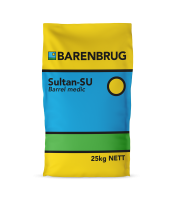
Sultan-SU
-
Early maturing (~70–90 days to flowering)
-
Good aphid resistance
-
Boron tolerant
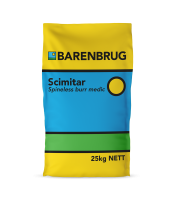
Scimitar
-
Demonstrates excellent salt tolerance
-
High percentage of soft seed (24%)
-
Adaptable variety which grows on a wide range of soils
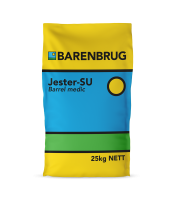
Jester-SU
-
Tolerance to sulfonylurea (SU) herbicide residues
-
Vastly improved aphid resistance
-
Regenerates well after cropping phase 1-3 years