
Recovery Management - Pasture recovery following a fire
The effect of fire on grazing land and its capacity to recover is highly variable. Fire intensity, duration, pasture composition, soil factors, stock management and farm operational tempo will all have a bearing on the approach required.
Introduction
The capacity for grazing land to recover from fire is largely dependent on factors that include:
• Pasture composition and fertility before the fire
• Intensity and duration of the fire: may depend on soil conditions and type/amount of ground cover
• Capacity to manage erosion risks
• Managing livestock, wildlife and feed budgeting during recovery
It may be the case on farms with a few paddocks burnt, that recovery may take place relatively easily and quickly, with some consideration to short-term feed budgeting. On the other hand, if considerable areas and infrastructure are lost, recovery in the initial year may satisfy immediate feed requirements, but it is likely to be several years to properly re-establish pastures and farm operations fully.
In many or most circumstances, a paddock by paddock individual assessment may be required.
Consider factors such as:
• Geography and location
• Slope and aspect
• Pasture type, composition and management history
• Soil features and fertility
• Utilisation needs and location of paddock on the farm
• Stock classes, feed budget and related farm operation tempo
• ‘Mix’ of recovering pastures, over-sowing, renovation and annual fast feed forages
• Capacity for implementation: logistics, finance, insurance related, farmer’s outlook
Whilst here may be a temptation to default automatically to offering lower priced options to assist farm finances, the principle will remain that sowing better options will benefit the farm – likely in the short-term and certainly in the longer term. Higher performing, resilient and well-adapted modern cultivars and mixes should constitute the majority of options recommended.
Pasture composition and fertility
Deep-rooted perennials such as phalaris, cocksfoot, tall fescue and lucerne will be the most resilient after fire. Shallower rooted perennials such as ryegrass and bromes less so, and annual species such as many weedy grasses will likely be greatly reduced in capacity to regenerate. Pastures containing a high proportion of less desirable perennials such as kikuyu, browntop and Paramatta grass may recover with these species increasing in their dominance. Recovery of clover content is likely to be highly dependant on the relative survival of seed reserves in the soil. Seed reserves will be affected by the intensity and duration of the fire, the soil type and the seed type and population.
In general terms, pastures with a satisfactory proportion of better, deep rooted species will tend to have a preferable level of soil fertility, and this may under-pin recovery in the short-term. It is often the case that weedier, annual pastures will have lower levels of fertility and such paddocks will likely require targeted fertiliser applications in order to get them productive in the first seasons following fire. Intensity and duration of fire will tend to affect some of the soil fertility properties.
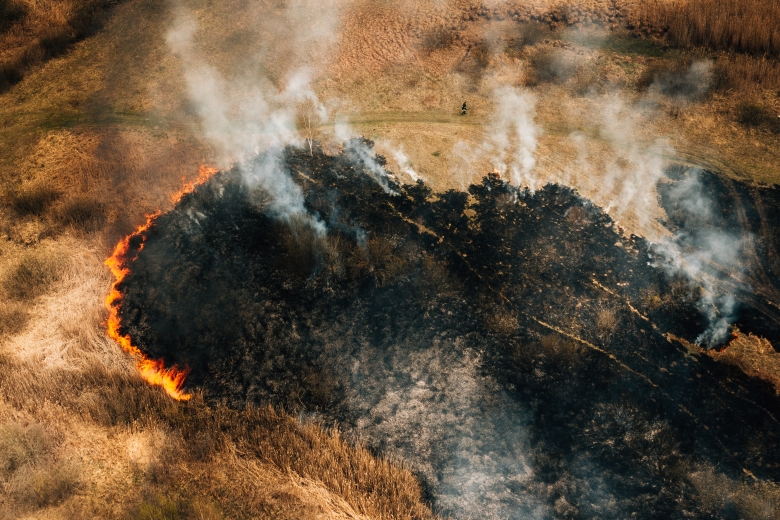
Intensity and duration of fire
Short duration, low intensity burn:
• Likely if there is short ground cover and/or some soil moisture prior to the fire.
• Burnt clumps and some residual pasture may remain.
• Retains most of the fertility, and especially nitrogen likely to be relatively available.
• Little if any long-term effect on the topsoil.
• Possible or probable that well-established perennials will recover satisfactorily.
• Probable that a high proportion of grass seeds will also survive – including weedy annuals.
• If the pasture has a good clover seedbank, it is probable that the legume component will revive satisfactorily.
• Generally, a low erosion risk and ground cover rapidly return after opening rains and re-seeding if that is desired.
• Cultivation may be useful to improve the presentation of the seedbed for reliable new pasture establishment.
Likely action:
Pasture will revive after a series of opening rains. If the
grazier needs fast feed, over-sow a suitable species or mix.
Longer duration, hot burn:
• Likely case if/when pasture cover is moderate to high or high residual crop stubbles, and/or if the soil has been very dry.
• Nitrogen levels likely to be severely reduced, potassium likely to be retained, phosphorus availability likely to be increased, possible short-term increase in top-soil pH.
• Hit and miss pasture recovery from existing perennials - phalaris, fescue, cocksfoot pastures may be OK.
• If the paddock has good fertility status it is likely to aid probability for satisfactory pasture recovery.
• Ryegrass pastures will very likely need to be re-sown.
• Cultivation for re-seeding not likely to be required as direct drilling will often be straight forward.
• Harrowing may be useful to uncover buried clovers seeds, although this may increase the emergence of broad-leaved weeds.
• Probable that a high proportion of grass seeds have been destroyed, with implications both for a re-seeding opportunity and reduction in weedy grasses for ensuing years.
Likely actions:
Phalaris, fescue, cocksfoot, lucerne: may be a good case to attempt to water some test strips to assess pasture survival.
Ryegrass and annual pastures: Likely require full re-sow. Soil test.
Opportunity to consider fast feed over-sow options in the program.
Very hot burn:
• Not common over large areas of existing pasture, although:
• May be applicable to burning windrows, hay bales, high organic matter (peaty) soils, a heavy pasture root mat, log-heaps or remnant bush/undergrowth/woody weeds etc.
• All living material on the surface or in the topsoil is destroyed.
• Soil likely be baked and soil chemistry somewhat or markedly altered.
• High erosion risk – action required swiftly.
• Likely that cultivation will be required to create a viable seedbed as well as a targeted fertiliser program.
Likely actions:
Consider erosion control if required
Soil test and re-sow with suitable new pasture for soil x environment x farm type and operational tempo.
Erosion management
Erosion risk increases with lighter soil types, lower organic matter levels, dispersive (high sodium, magnesium) soil types, slope, intensity of rainfall, wind and over-stocking. Some potential considerations for mitigating the potential for erosion include:
• Use of stock containment areas / sacrifice paddocks.
• Retain any remnant stubble burnt or otherwise.
• Consideration to careful deep ripping or delving of soils to produce large soil lumps (>10cm) at the surface to reduce wind speed at ground level. This is a more reliable technique for medium – heavier soil types, and possibly avoided for very light soils with low clay or organic matter levels. Ripping along contours will likely improve prospects for water infiltration in the event of rain.
• Use of semi-permeable silt barriers to reduce the speed of water in run-off areas.
• Including a ‘cover-crop’ of fast establishing species as a proportion of re-sown pastures. Forage cereals such as oats, cereal rye, and barley are ideal options in late summer/early autumn and tolerate some wind-blasting. Annual ryegrass may also be satisfactory as well as some brassica options.
• Wait until pastures attain satisfactory ground cover before grazing.
• Reduce grazing duration to less than three days and adopting quick rotations.
• Use of portable, electric fences until permanent infrastructure is re-established.
Feed and stock management considerations
It is highly recommended to containment feed stock until there is adequate regeneration or re-establishment of pastures. Continuous grazing of dry or low ground cover pastures may increase the risk of erosion as well as delay pasture recovery considerably. Consideration of wildlife and game may be required, and there will be aspects to reflect upon such as the state of boundary fencing and possible sensitivities around wildlife recovery.
Plan on allowing at least 6-8 weeks after breaking rains prior to re-stocking fire-affected pastures; this will have implications for containment feeding time-frames and brought-in feed requirements even after the autumn break. As far as possible, allow pasture legumes to reach 3-4 leaves and grasses and cereals at least around 1,200 – 1,400 kg/ha dry matter: around ankle height. Higher ground cover is preferable: 2,200 – 2,500 kg/ha, but this may not be possible in all cases. Re-commence rotational grazing as soon as possible to aid grass recovery after grazing and to allow physical space for legume re-establishment. Ideally, grazing duration ought not exceed three days. After two to three days, new shoots will be emerging, and these will be contributing to the next grazing round as they grow. Continual grazing and defoliation will reduce the pastures’ root system and its capacity to regrow. It is highly likely that there will be loss of fencing and associated infrastructure. If the situation allows, consider the use of portable electric fencing options in order to improve stock management capacity.
Expect that farm / pasture carrying capacity on recovering pastures will be reduced for at least the first year, to about 60-70% of pre-fire levels, with average rainfall patterns. Carrying capacity may potentially be improved by utilising short-term winter active annuals such as annual or Italian ryegrass and forage cereal options. Be sure to assess what proportion of the farm this applies to as too heavy a reliance on annual options may create a feed gap in the following summer and autumn.
We’re here to help.
Our team of experienced Territory Managers are ready to provide you with specialist advice.
Start a conversation today.