
Ryegrass Pasture Pest Management Update 2026
Ryegrass endophytes such as NEA, NEA2, NEA4 and NEA12 provide protection against some critically important pasture pests in established ryegrass pastures. Seedling ryegrass plants have little protection from pests such as African black beetle and Argentine stem weevil. Use of these endophyte options in hybrid and perennial ryegrasses is recommended in situations where these pests are likely to be found. It is highly recommended to adopt a program of using an appropriate seed treatment for emerging pastures together with suitable varieties of ryegrass with tolerance to these pasture pests.
Chlorpyrifos insecticide is no longer available for use in pastures
From September 30th 2025, the Australian Pesticides and Veterinary Medicines Authority (APVMA) implemented a significant change in the registered use of chlorpyrifos insecticide for use in pastures and forages. This follows the withdrawal for use in pastures and forages of fenitrothion in 2024.
Chlorpyrifos, also know as Lorsban, has been a highly reliable tool for the management of various pasture pests, during ground preparation, pasture emergence, and for established pastures and forages.
Options for control of white-fringed weevil, wireworms, cutworms, are now very limited, whilst there are no registered in-crop control options at all for African black beetle, Argentine stem weevil or corbie grubs.
There remain some insecticides that may be used in pastures that could have some efficacy on these pests, but are not registered for these purposes.
An alternative approach is required to improve the prospects for pasture establishment and maintenance, with includes using ryegrasses that have endophytes that deter these pests, together with appropriate seed treatment to protect establishing seedlings.
African Black beetle (Heteronychus arator) (ABB)
Period of pasture damage: spring to autumn
ABB is a pest of free draining soils in warmer regions of southern Australia but absent from Tasmania. Numbers vary widely from year to year, and can increase rapidly when conditions are right, and numbers may stay high for several years. ABB is typically found in areas where summer active grasses such as kikuyu, couch, paspalum etc. thrive and co-exist within ryegrass pastures: coastal southern Victoria (Gippsland and W. Vic), south coast NSW, and parts of the Riverina and higher rainfall areas of inland southern NSW.
Root feeding larvae are capable of causing severe pasture damage in summer. Adult ABB feed on the roots and the crown of the plant and can decimate new grass sowings in autumn. Seed treatment is essential for protection of new sowings, especially if spray-drilled or over-sown, as the insect population is not controlled in the absence of cultivation. Weakened plants are susceptible to pulling during animal grazing. Damage is most apparent in dry summers when larval numbers are above 40/m². Larval damage can be severe in newly sown pastures.
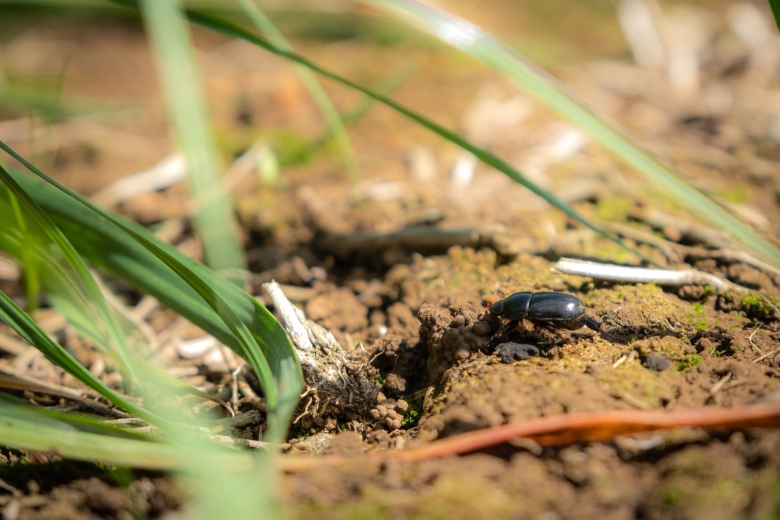
When renewing pasture in an area with a high risk of ABB:

- Consider break crops. ABB doesn’t dwell with brassicas, chicory or maize for example. Cropping prior to pasture renewal will reduce populations.
- Before sowing, eliminate any grass weeds to remove this food source for ABB.
- Assess ABB populations from early February before finalising sowing plans.
- Cultivate if beetle populations are high. Cultivation significantly reduces numbers of adult beetles and larvae. The threshold for action is >15-20/m² of adults and larvae.
- Sow ryegrass with the right endophyte. NEA, NEA2, NEA4, NEA12 and AR37 are the most successful novel endophytes for control of adult ABB. AR1 is not recommended.
- Always sow Poncho-Plus treated seed. This is essential to protect establishing grass plants. Endophyte provides minimal protection for ryegrass seedlings during establishment.
- Use lime to improve soil pH. Trials have shown applying lime in spring to raise the soil pH to 6 resulted in up to 40% less BB larvae than control treatments.
NEA, NEA2, NEA4, NEA12 or AR37 endophyte all give good control of ABB by reducing adult feeding, egg laying, and hence larval damage. They do not directly affect ABB larvae. AR1 endophyte does not provide effective ABB control and should not be used where ABB is a risk. No endophyte gives complete resistance, and all ryegrasses may still be damaged in problem areas in summer dry conditions. From October 2025, no insecticides remain registered to control ABB in pastures.
Argentine stem weevil (Listronotus bonariensis) (ASW)
Period of pasture damage: October-April
ASW is an occasional ryegrass pest in ryegrass predominant pastures in southern Australia, but there are some seasons and ‘hot spots’ where ASW may be of economic importance. Once grass is established, there are effective endophyte options to assist with longer term management.
In New Zealand, Poncho seed treatment is registered and recommended for sowing ryegrass where adult and larval ASW are potential problems. In Australia, it is likely that ASW damage may be significantly reduced at pasture establishment, with a suitable seed treatment, but note that none are registered for this specific purpose.
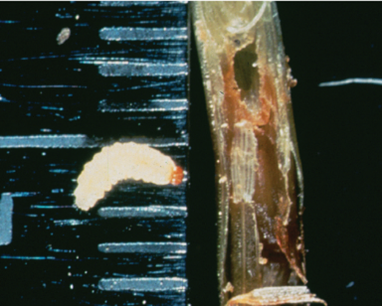
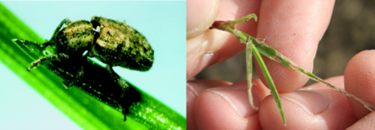
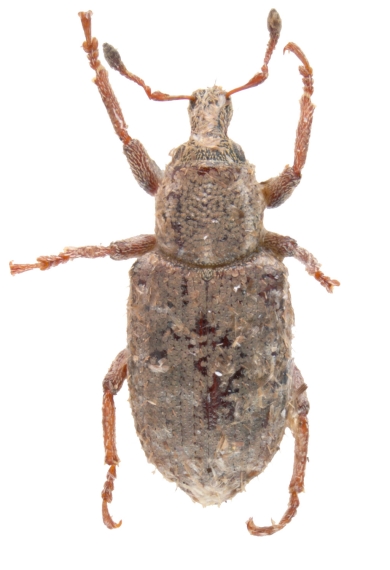
Larval damage mainly occurs from mid-October to mid-April. It is usually seen when pastures are growing slowly and is often confused with drought stress. In most areas, ASW have two generations a year, one in spring and another in summer. Generally, the summer generation is the most damaging, between December and March. Adult weevil feeding is characterised by small rectangular ‘windows’ 2-3 mm long on the leaf blade (shown in photo). Adults seem not to seem to affect the persistence of established pasture, but can kill grass at establishment. This is most common in grass to grass or cereal to grass sowings with minimal tillage, or when over-sowing into existing pasture. Cultivation reduces ASW numbers, however if turf or plant sods remain intact, ASW may survive. In dry conditions, slow establishment plants will endure a longer period of vulnerability.
In grass to grass or cereal to grass spray-drill situations where ASW numbers can be high, it may be possible to add an appropriate insecticide to the final glyphosate spray before sowing to reduce the ASW population, whilst addressing other insect pests.
The endophytes NEA, NEA2, NEA4 and AR1 give some protection in newly sown pastures, but not as much as seed treatment. Janthitrem endophytes AR37, NEA12, RGT18 and ryegrass without endophyte give seedlings no protection against adult ASW.
Endophyte is an important tool for ongoing ASW control in a pasture. Once established, diploid perennial ryegrass containing NEA2, NEA4, NEA12, AR1, AR37 or RGT18 endophytes are likely to provide good ASW control in most situations. Tetraploid cultivars are often more susceptible to ASW damage.
ASW may be confused with, or co-present with other weevils such as Sitona weevil or White-fringed weevil which have not been examined for control by endophytes.
Seed Treatment – Poncho Plus
The endophytes in modern elite ryegrasses are extremely useful for managing these pasture pests, but emerging seedlings require protection until the endophyte establishes well enough to protect the grass.
Poncho Plus is available as a seed treatment option with Barenbrug pasture varieties and mixes. Poncho Plus is registered in Australia for efficacy on the following pests in grass pasture:
• Lucerne flea
• Red-legged earth mite
• Blue oat mite
• Cutworm
• Yellow-headed cockchafer
• African black beetle
There is no registration for Argentine stem weevil in Australia.
In Australia, Poncho Plus contains 360g/l clothianidin and 240g/l imidacloprid and is used at a rate of 500ml/100kg seed: effectively 180g clothianidin/100 kg seed.
The grazing withholding period for Poncho Plus is 6 weeks for grass pastures, and 8 weeks for pastures containing broad-leaved species such as clovers, chicory, plantain or brassicas etc.
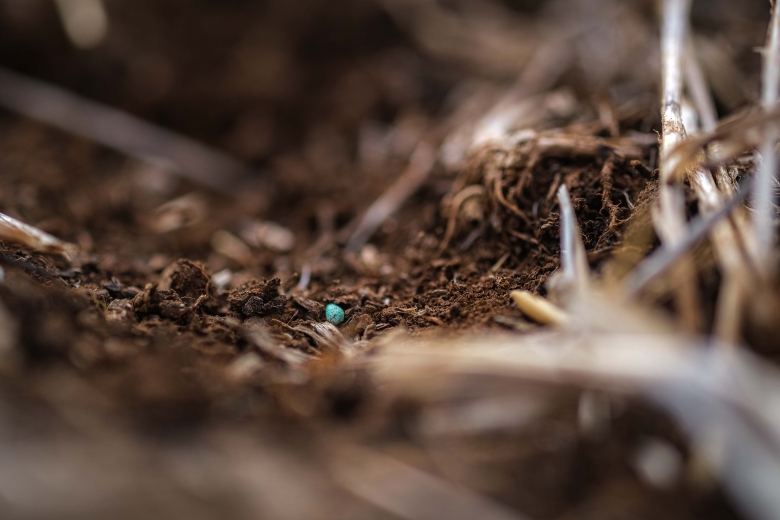
New Zealand influence and comparison
Elite varieties of new ryegrass cultivars are often developed with breeding partners in New Zealand where a high level of technical expertise resides. This includes the application of endophytes to aid with aspects of pasture pest tolerance.
In New Zealand, is very much standard practice to utilise ryegrasses with pest-protecting endophytes in combination with Poncho seed treatment where pest pressures are typically high, particularly ASW and ABB.
It should be noted however, that the formulation and application rate of Poncho in New Zealand varies from that in Australia. Poncho in New Zealand has a different formulation with a higher loading of clothianidin (600g/l), and a use rate of 450ml/100kg seed, effectively 270g clothianidin/100kg seed.
Poncho in New Zealand has registration for control of ASW. In Australia, with the different formulation and with perhaps other factors at play, it is not registered for this purpose. Information and techniques developed in New Zealand may not be entirely transferable to Australia in some circumstances, or there may be limitations to their applicability.
Farming system and ground preparation pre-sowing.
It has been a very common practice to utilise a broad-spectrum insecticide such as chlorpyrifos with glyphosate knock-down sprays prior to sowing. There are no longer any insecticides specifically registered for control of ABB nor ASW. There do remain some insecticide options for use in pasture for other target species such as cutworms, Sitona weevil and Heliothis, thus potentially enabling the inclusion of insecticides in pasture preparation.
Assessment of potential threat from ASW or ABB should be made from around late summer as the sowing window approaches, together with knowledge derived from experience and local expertise. The following chart provides options to consider for new ryegrass pasture establishment where ASW or ABB may be present:

Beneficial endophytes from Barenbrug
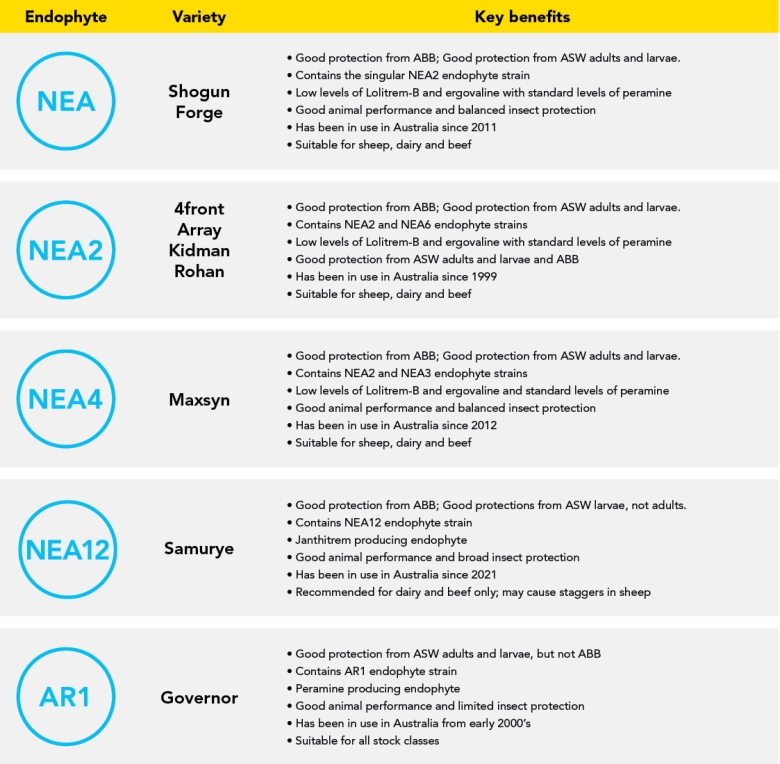
Barenbrug Australia’s range of perennial and hybrid ryegrasses and their endophyte partners have been developed with the best balance of performance, utility and persistence.
Varieties to consider:
4front NEA2
-
Tetraploid perennial ryegrass for high performance
-
Late to very late flowering for retained feed quality
-
Provide long term pasture for highest productivity
Forge NEA
-
Highly recommended for ryegrass systems
-
Improved performance over perennial options
-
Exceptional winter and early spring yield
4front NEA2
-
Ideal for cool season race tracks
-
Dark attractive colour
-
Excellent root development
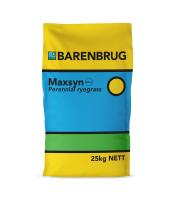
Maxsyn NEA4
-
Unrivalled forage production for more low cost ‘home grown feed’
-
Fill critical feed gaps in both autumn and spring
-
Mid-late flowering