
Unlock Your Pasture's Potential with Hybrid Ryegrass
Hybrid ryegrasses combine the best traits of Italian and Perennial ryegrass, delivering exceptional yield potential alongside dependable persistence over multiple years.
What is a hybrid ryegrass?
Italian ryegrasses typically outyield perennial ryegrasses, particularly in terms of cool-season growth potential. Perennials have the capacity to reliably survive and produce for many, many years. Hybrid ryegrasses are a category that offer yield potential approaching that of Italian ryegrasses, with reliable persistence over several years – usually greatly exceeding the persistence of Italians.
Plant breeders make selections of theses hybrids from natural populations or (more typically) make crosses between elite Italians and perennials. For most practical discussions, it is useful to think of hybrids as offering greater per annum yield potential than perennials, with good prospects of 2,3,4,5 or more years of productive life depending on the variety, situation and management.
What kinds of hybrids are there, and what do they potentially offer?
| Italian Hybrids | (Italian x Perennial) x Italian These are typically considered as the same type of performance potential as a similar class of Italian ryegrass. The minor inclusion of some perennial genetics offer prospects for a decent second year of production, usually more reliably than what an Italian may offer. |
|---|---|
| 50/50 Hybrids | Italian x Perennial This category offers the strongest potential for two-to-three-year persistence with annual yield potential approaching or often exceed that of elite Italian ryegrasses. |
| Perennial Hybrids | (Italian x Perennial) x Perennial These types have a greater proportion of perennial ryegrass in their breeding, thus conferring very good prospects for many years of highly productive stand-life. |
| Functional Hybrids | The are very few of these types of ryegrasses. In essence they are not a hybrid per se, but a ryegrass that is botanically classified as an Italian ryegrass and behaves like a hybrid or perennial ryegrass. It has the ability to survive over multiple years like a perennial, yet offer cool-season and spring performance approaching that of Italian ryegrasses. The most widely used example in this category is Barberia. |
| Festuloliums | Meadow Fescue x Ryegrass Meadow fescue – ryegrasses crosses occur in nature and have been targeted by plant breeders. Meadow fescue is a relatively poor producing feed source compared to perennial ryegrass, and the benefits of these crosses rarely manifest as a good solution for productive results. |
How reliably do they persist after summer conditions in Australia?
Hybrid ryegrasses, like Italians have a high proportion of vegetative tillers, and have good potential to come back next year if these tillers can survive the summer. Cooler temperatures, irrigation or rainfall, good fertility, and grazing management will help this. In the right environment, a hybrid ryegrass will potentially behave more like a perennial and last many years, particularly if the variety has been bred with a significant proportion of perennial genetics.
Hybrids have their best application in areas that can reliably or at least marginally produce perennial ryegrass pastures. Hybrids are not really suited to situations where the spring season cuts short due to higher temperatures through spring or summer dry conditions, e.g. inland mixed-cropping zone, sub-tropical dairy zone. In such situations, stick to using annual or Italian ryegrasses.
Given a generous and long spring, good nutrition and careful management over summer, these multi-year hybrids reliably bounce back after summer and offer great utility as autumn ensues, or with the aid of irrigation.
What are the applications for hybrid ryegrasses?
Italian ryegrasses are very good at producing high yields of quality feed for one year, and if conditions and management allow, there may be prospects for a second year of production. Hybrids can be used in exactly the same fashion as Italians, with the added benefit of improved prospects for persisting for a year or more longer. Inclusion of some perennial genetics or habit through breeding and selection has created these hybrid types that approach the same sort of performance as Italians, yet have the capacity to perform over multiple years.
Hybrid ryegrasses are not likely to be of benefit in situations where perennial ryegrasses never reliably survive in summer conditions from heat or humidity. In such cases, annual ryegrass or Italian ryegrass programs should be used instead.
Hybrid ryegrasses will have terrific utility in the following situations:
- High performance ryegrass pasture for 2, 3, 4, 5+ years, depending on the type of hybrid
- Excellent cool-season performance for winter feed
- Big silage or hay production with prospects for multiple cuts
- Irrigation
- Over-sowing into existing, partially run-out pastures
- Over-sowing into thinning lucerne or chicory stands
Where to use which hybrid ryegrass:
| 650mm+ rainfall/irrigated, maximum yield for up to two years: | Regain hybrid ryegrass (Italian hybrid) |
| 650mm+ rainfall/irrigated, maximum yield for three years: | Shogun NEA hybrid ryegrass (utility/most situations) Samurye NEA12 hybrid ryegrass (beef/cattle/dairy only) |
| 650mm+ rainfall/irrigated, maximum yield for 4-5 years: | Forge NEA hybrid ryegrass (perennial hybrid) |
| 500mm+ rainfall summer dry, persist for 3-5 years+: | Barberia ryegrass (functional hybrid) |
| 1-2 year Italian-Hybrid ryegrasses (75% Italian:25% perennial) | 2-3 year+ Hybrid ryegrasses (50% Italian:50% perennial) | |
|---|---|---|
| Productive life-span: | 1.5 - 2 years | 2-3 years+ |
| Relative cool season growth: | 4/5 | 4/5 |
| Relative late spring feed quality: | 4/4 | 4/5 |
| Relative cost of seed: | ||
| Used for: | Similar performance to true Italian ryegrasses, but where a producer would like the prospects for a reliable, full second year of production; or to utilise an Italian for productivity, although has flexible plans for the following year i.e. creates an option to keep the paddock for one more year. | Similar performance to true Italian ryegrasses, but where a producer would like the prospects for a reliable, full second and third year of production; Italian-type per annum productivity, good prospects for yield in subsequent 1-2 years and creates options for the future if plans alter. |
| Variety: | Regain Hybrid | Shogun NEA, Samurye NEA12 |
| 3-5 year+ Hybrid Perennial ryegrasses (25-12% Italian:75-88% perennial) | 3-5 year+ Functional hybrid ryegrasses | |
|---|---|---|
| Productive life-span: | 3-5 years+ | 3-5 years+ |
| Relative cool season growth: | 4/5 | 4/5 |
| Relative late spring feed quality: | 4/5 | 2/4 |
| Relative cost of seed: | ||
| Used for: | Higher rainfall or irrigated applications requiring the high reliability of a multiple-year grass, with higher per annum yields than perennial ryegrasses, (approaching the yield potential of an Italian ryegrass). A good option for situations that would consider using a perennial, although a 4–5-year time frame is sufficient for the system or rotation; or where there is some unreliability for a true perennial to persist reliably beyond 4-5 years. | dry-land, early finishing sites requiring the high reliability of a multiple-year ryegrass, with higher per annum yields than perennial ryegrasses, (approaching the yield potential of an Italian ryegrass). A good option for situations that would consider using a perennial, although a 4–5-year time frame is sufficient for the system or rotation; or where there is some unreliability for a true perennial to persist reliably beyond 4-5 years. |
| Variety: | Forge NEA | Barberia |
Notes:
Productive life-span: indicated typical reliable period of utility when autumn sown. Variations will occur depending on sowing times, seasonal conditions and geography.
Relative cool season growth: indicative scale growth potential where an early-mid maturity annual with good modern genetics and well managed can achieve five out of five. An un-blued indicates a level of cool-season activity that sits mid-way to the next upper level, or expresses some variation depending on conditions etc.
Relative late spring feed quality: relative scale out of five, where five equals feed quality during vegetative growth stage. As grasses mature and go reproductive, the proportion of stem increases, reducing energy levels, protein and increasing fibre thus limiting intake. Varietal selection through modern genetics, sowing later varieties, seasonal conditions, pasture management, harvest timing will all contributing to determining the potential feed quality of fodder production or late season grazing.
Relative cost of seed: seed price for quality options and utility is an investment. This $ relationship is roughly compared to the price of elite perennial ryegrass as a rating of fifteen $.
Varieties to consider:
Shogun NEA
-
Very strong establishment vigour
-
Improved persistence over other hybrid ryegrasses
-
Reliable 3–4 years of production
Samurye NEA12
-
Partnered with NEA12 endophyte for improved pest tolerance and yield production
-
Use a sole grass high performance pasture
-
2–4-year pasture
Forge NEA
-
Highly recommended for ryegrass systems
-
Improved performance over perennial options
-
Exceptional winter and early spring yield
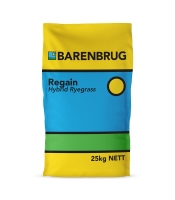
Regain Hybrid
-
Late maturity
-
Perfect for over-sowing run down pasture
-
Late season quality