
Arise
#1 ranked Italian Ryegrass in the 2024 & 2025 Dairy Australia (FVI)
-
High forage yield
-
Quick establishment for early feed
-
Capable of multiple grazings

Arise is the newest late maturing tetraploid Italian ryegrass (+15 days) bred by Barenbrug.
Offering quick establishment for early feed and a wide growth period, providing quality feed throughout the year.
Arise is capable of multiple grazings throughout late autumn, winter, early spring and late spring, with the ability to produce quality feed in a second year under the correct conditions. This provides the benefit of a more productive pasture to grow more home-grown feed for your livestock. Suitable for over sowing into existing pastures for a boost to establish quick feed options, reducing the need for winter supplementary feeding and aiding to fill the winter feed gap.
Key Features
- Tetraploid Italian ryegrass
- High forage yield
- Great all-season performance
- Fast establishment and great winter yield
Benefits of sowing Arise
- More home-grown forage for milk, meat and hay/silage
- Helps to fill the autumn and winter-feed gaps
- Produces excellent quality forage for livestock
Performance
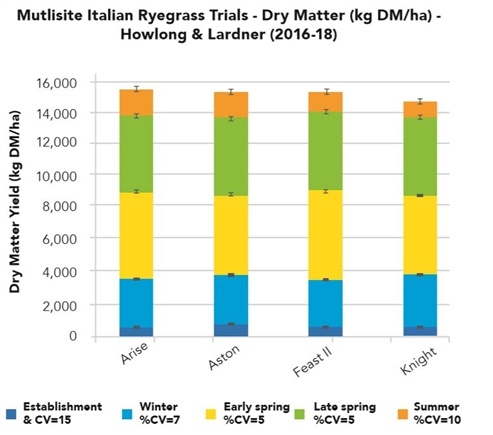
Arise consistently demonstrated strong performance over different trial locations and years. Topping total yield (approx. 15500kg DM/ha) across Howlong and Lardner Park multisite analysis from 2016-2018, outperforming Aston and competitor varieties across these trials.
The late heading of Arise and strong yield performance from during early and late spring allows producers to get the most out the variety throughout the growing season.
Arise is also able to push through to a second year under favourable seasonal conditions and provide valuable autumn feed heading into winter.
- Agronomy and Management
Fertiliser
For best performance, soil fertility and acidity problems should be amended prior to sowing. It is usually best to plant ryegrass with 60-100 kg/ha of MAP or DAP at sowing to provide some starter phosphorus and nitrogen.Weeds
Ideally reducing the weed burden of a paddock should commence in the season prior to sowing by reducing the seedset of annual weeds with either a herbicide control or silage. Additionally a knock-down herbicide (such as glyphosate) is best applied prior to sowing if weeds are present.Grazing
Ensure the first grazing doesn’t take place until the plants are sufficiently anchored. Use your hand to pull on the plants at grazing height. If the plants remain in the ground, then grazing can commence. Ideally, ryegrass should be rotationally grazed for optimal growth. To do this, graze at the 2.5-3 leaf stage, then let the plants rest again to the 2.5-3 leaf stage to re-charge the carbohydrates levels to enable better growth rates.
Specifications
| Name | Value |
|---|---|
| Sowing rates | 25-35 kg/ha |
| Sowing depth | 5-20 mm or in a mix with clover: 5-10mm. |
| Rainfall requirement (min) | 650mm+ per year |
| pH | 4.8-8.0 |