
Interval
Extremely vigorous rape-kale cross, that is fast establishing with excellent first grazing yield.
-
Excellent first grazing yield
-
Produces high energy and high protein forage
-
Strong frost tolerance

Interval forage rape is an extremely vigorous and fast establishing rape-kale cross. Additionally, the Poncho® Plus coating provides it up to 4 weeks protection against insect attack.
Interval can be sown from spring through to mid autumn to provide a bulk of high quality feed in approx 56–84 days. Late spring sowings can be grazed in summer/early autumn then let to re-grow for winter feed. Grazing can start as early as 8 weeks after sowing depending on the start to the season, but would normally commence at 12 weeks for the first grazing.
Key Features
- Fast growing and high-yielding
- Maturity typically 12 weeks, but can be grazed within 8 weeks under some conditions
- Produces high energy and high protein forage
- Strong frost tolerance and resistance to powdery mildew
Benefits of sowing Interval
- Interval can produce up to 14 tonne (DM) of forage under ideal conditions
- Suitable for either autumn or spring plantings
- High quality forage for livestock - better suited to cattle than sheep due to height
- Can be used as part of a long-term rotation to control weeds prior to permanent pasture sowing
Performance
2019 Autumn sown forage brassica trial (Howlong NSW) Sowing date 6/4/2019. Kg dry matter.

- Agronomy and Management
Interval rape has shown a very good leaf to stem ratio compared to other varieties on the market. Crops of Interval rape have measured 19% CP (crude protein) and 13.4 MJ/kg DM (energy).
Excellent regrowth after grazing can be obtained through good management practices ie. back fencing with an electric fence. You can expect up to 3 ton of dry matter at the first grazing and with re-growth you can possibly gain an extra 10 ton of dry matter from two additional grazings under ideal conditions. The added advantage is that you can let Interval grow into the winter months if that suits your rotation, and by adding some Tempo Italian ryegrass as an over sow you can take the paddock through for a silage or hay crop as well as obtaining good grazing along the way.
Monitor early for evidence of pests, such as slugs, RLEM, Lucerne flea and Cutworm
Once at ground cover consider a topdressing application of Nitrogen, as Urea
Check for leaf chewing pests, such as Diamond back moth and treat as required
As with all forage brassica crops, care needs to be taken in introducing livestock to the forage crop to avoid animal health problems. Follow animal introduction instructions from your agronomist or animal health expert
Apply sufficient starter fertiliser, such as DAP/MAP at 100kg/ha

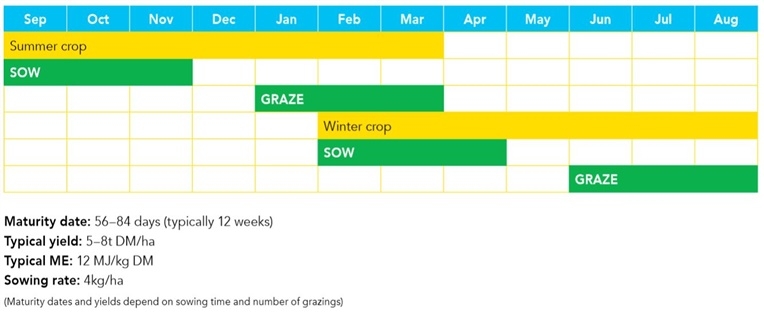
Specifications
| Name | Value |
|---|---|
| Rainfall requirement (min) | 450mm |
| pH | 5.5-8.0 |
| Sowing rates | 4-5kg/ha |
| Sowing depth | 1-2cm |