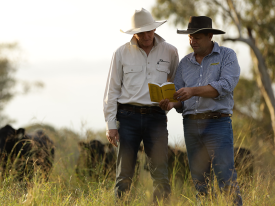
Hay production exceeds expectations with Endura Rhodes grass
The switch to Endura Rhodes® grass has seen hay production almost double this season for Stewart Hay, a grower and beef producer at Taroom in central Queensland.
The new variety proved its frost resilience, bouncing back quickly after surviving the most severe frost events seen in the area for two decades.
Running about 1300 head of cattle and growing hay and oats across just over 4000 hectares, Stewart hay made the decision to try Endura Rhodes on the recommendation of Campbell Watson at Watson Stock Feeds in Taroom.
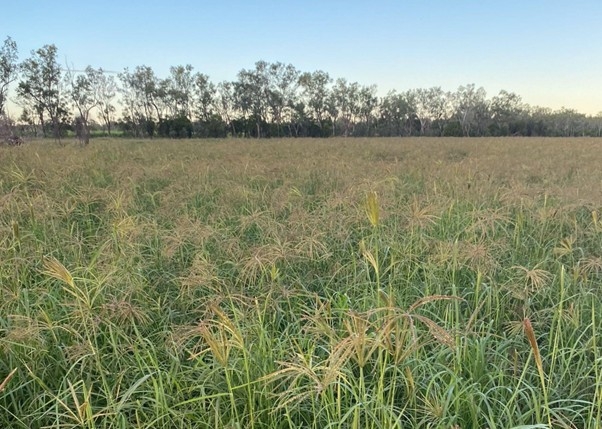
It’s a decision which Stewart says was definitely the right one, after planting Endura Rhodes across forty hectares with a spreader in late January, on an area which had previously been used for wheat.
“All I wanted to achieve was to get the same dollar value I could get out of wheat, out of my country or a bit better,” Stewart says, "We're getting more dollars per hectare out of growing this than growing wheat, with less input”.
Stewart planted Endura Rhodes at 10kgs per hectare. He sprayed the crop for weeds once and made one application of liquid fertiliser in April, before it was baled for hay in June.
“We had a really good grass growing season, so it was probably a bit out of the ordinary, but I'll take it any year, what happened this year,” Stewart says. “Before we baled it, I was telling people about it and people were coming here to have a look at it, but they couldn’t believe the volume of feed.”
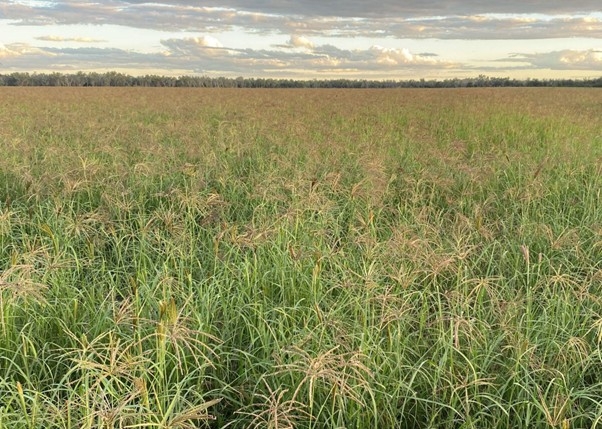
The final yield was almost double Stewart’s previous variety, producing 810 bales, with the majority sold to the local stock feed supplier.
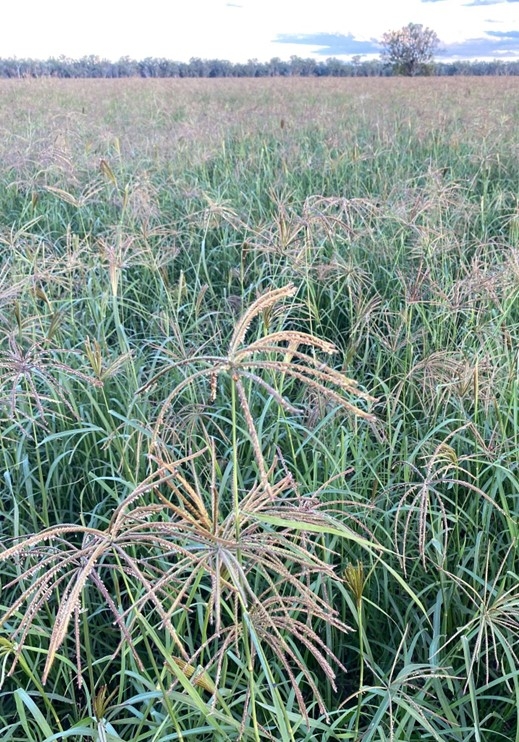
The rest were used to feed Stewart’s weaners, where he found that Endura Rhodes’ thin stem meant the cattle didn’t waste anything, “They don't pull it out, eat the leaf off it, and there's a heap of stem laying down on the ground. They eat the whole thing,” Stewart says.
The frost resilience of Endura Rhodes was the other standout feature for Stewart, who saw how other varieties were unable to withstand a week of severe frost events in the region.
“As soon as it warmed up with this Endura, within a week the whole paddock was green. It was dormant, not frosted. Whereas the other stuff was frosted,” he says.
“We had about 20mm here in early August, and the other stuff, it still hasn't responded because it was dead to the ground. The Endura is nearly knee high.”
Stewart is preparing to plant another 40 hectares of Endura Rhodes mixed with lucerne, and plans to expand its footprint on his property to 120 hectares by the end of next summer.
He says he would love to see what the crop was able to do if he could irrigate it.
“Once it’s in you don’t have to plant it, you just spray the weeds out once a year,” he says, “You don't have to keep it all fallow for six months. The money we are making off the country compared to growing wheat is what I wanted to achieve.”
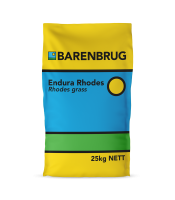
Endura
-
Well suited to grazing, reclamation and soil conservation activities
-
First choice for high quality Rhodes hay
-
High leaf to stem ratio