Morava
Produces high levels of dry matter while still providing high grain yields.
-
Resistant to Rust and tolerant to Ascochyta
-
Vigorous early plant growth and good grazing palatability
-
Improve soil health through increased nitrogen fixation

Morava is a high performing ‘common’ vetch which is suitable for grazing, green manuring, making hay/silage and as a disease break in cereal farming rotations. Morava is soft seeded and produces high levels of dry matter while still providing high grain yields. Good disease resistance makes Morava the best vetch option for areas receiving greater than 300mm annual rainfall.
Key Features
- Resistant to rust and tolerant to ascochyta
- Soft seeded, non-shattering
- Improved soil health through increased nitrogen fixation
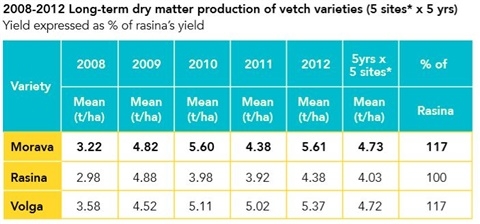
- High yield Potential – 17% over Rasina in trials
Benefits of sowing Morava
- Replacement for current varieties in areas with average rainfall above 300mm
- Suitable for green manuring and grazing
- Vigorous early plant growth and good grazing palatability
Growth Appearance
In the early stages of growth, Morava has reddish leaves and shoots which later turn dark green in colour. It has red/purple flowers and the seed coat is dark brown with beige coloured cotyledons. This compares with Blanchefleur which has light green shoots and leaves, white flowers, smooth light brown seed coat, and orange cotyledons. Morava has shown to produce longer shoots and much larger leaves than Blanchefleur and Languedoc.
- Management and Agronomy
Regeneration
Morava has 90–95% soft seed. This is a significant advantage in the reduction of volunteer vetch plants for following seasons for short term cropping rotations. Morava pods demonstrate a longer non shattering period compared to other Common vetch varieties such as Blanchefleur and Languedoc, meaning that seed harvest can be delayed slightly without suffering from a significant yield penalty.Grazing
Vetch is not suited to close grazing as its growing points are well above ground level. However, in longer season environments, Morava can be lightly grazed successfully during winter and early spring, provided the growing points are not damaged. Heavy grazing can cause significant damage to the plant and it may not recover. Bloat can be a problem on pure legume stands and stock will have to be watched carefully if grazing green vetch paddocksDisease / Pest Resistance
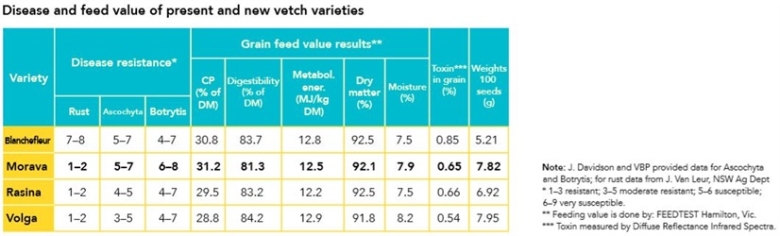
Morava, as with all common vetch varieties, is susceptible to red legged earth mites (Halotydens destructor), native budworm (Helicoverpa punctigera) and lucerne flea (Sminthurus viridis). Appropriate control measures should be taken, especially in seedling stands.Older vetch varieties, Blanchfleur and Languedoc, are very susceptible to rust, (caused by Uromyces viciafabea), and ascochyta blight, (caused by Ascochyta spp). Morava however is resistant to rust and tolerant to ascochyta. In screen field and glass house tests since 1992, Morava has been resistant to showing any pustules, whereas Blanchefleur and Languedoc were susceptible, showing pustules on stems and leaves. Morava is a good option in areas where rust occurs.

Specifications
| Name | Value |
|---|---|
| Rainfall requirement (min) | 350mm-600mm |
| pH | 5.0-8.0 |
| Soil type | Most well drained |