Sub Clover Seeds

Sub-clovers are one of the most widely used multipurpose pasture legumes used to supply high feed quality and enhance soil health.
The term sub-clover refers to a group of three species:
| Seed type | Soil pH | Soil Type | Rainfall | Sowing Rate | |
|---|---|---|---|---|---|
| ssp subterraneum | Black seeded | Acidic (4.5) – neutral | Most soil types | Low-medium | 6 – 10 kg/ha (in a mix) |
| ssp yanninicum | White seeded | Acidic – neutral | Medium-heavy | Medium | 6 – 10 kg/ha (in a mix) |
| ssp brachycalycinum | Mildly acidic (4.8) – alkaline | Medium-heavy | Medium | 8 – 12 kg/ha (in a mix) |
Sub-clovers can contain varying levels of phytoestrogens that may affect fertility in sheep, although more recent varieties generally have lower levels. Sub-clover can
cause bloat. They are usually quite susceptible to RLEM; monitoring and control is needed for best performance.
Seeds are relatively large and sowing rates need to be 2 or 3 times higher than most other clovers in order to reach a similar plant density. Sub-clovers are annuals and self-seeding and re-generation is required for contributing to perennial swards. Once a pasture has been established with sub-clover, a couple of years of re-seeding and a proportion of hard seeds, will help create a seed bank to back-up the occasional failed season.
Sub-clovers have been developed for varying rainfall and flowering dates. It is highly recommended to sow at least two varieties with differing flowering dates, so as to allow for a spread of flowering and seed-set as frosts, drought, grazing, pests and herbicides may reduce seed set or cause failure. In areas with an early spring, it is suggested to sow an early and a mid-flowering type. In later areas, sow a mid-maturing and a late variety. Levels of hard-seed will vary between cultivars, although most varieties have at least some hard seed component.
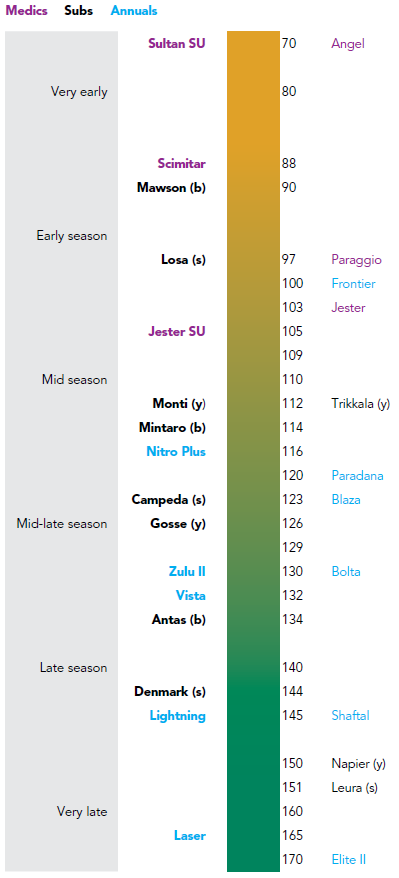
Varieties to Consider
Losa
-
Superior early vigour and improved autumn and spring production
-
Persists well in various soil types
-
Suited to lower rainfall areas and cropping rotations
Monti
-
Well suited to areas receiving 450−650mm annual rainfall
-
For use in permanent or long term phase pastures
-
Produces excellent early winter growth
Mawson
-
High levels of hard-seed (43%) and good seed burial
-
Excellent long term persistence for lower rainfall environments
-
Improved forage yield over other early-maturity subs
Mintaro
-
Good hard seed levels for long term persistence
-
Suitable for mildly acid through to alkaline soils
-
Large leaved, upright, very productive variety
Campeda
-
High seed yield resulting in excellent regeneration
-
Superior winter vigour, high production and disease tolerance
-
Ability to utilize background rhizobium better than other subs
Antas
-
One of the highest dry matter producing Sub clovers available
-
Persists well in various soil types
-
Strong growth through autumn and winter
Denmark
-
Resistant to clover scorch and root rot
-
Persists well on moderate to heavy soil types
-
One of the only subs that can continue to grow after flowering
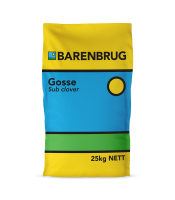
Gosse
-
Suited to regions with a 7 month growth period
-
Suitable for medium to high rainfall zones
-
Low oestrogen levels