
Quality pasture unlocks productivity gains for Warialda cattle breeders
The ongoing improvement of pastures with sub tropical grasses has enabled Warialda Angus breeders, Ben and Wendy Mayne, to unlock huge productivity and efficiency gains across their beef cattle operation.
The pair first introduced tropical grass species in 2004 and a tailored mix of varieties including Barenbrug’s Megamax® 059 panic grass has seen their seed stock operation Texas Angus maximise the potential of a wide range of challenging soil types on several
properties. “As we’ve done that, the production level per hectare or per property has increased dramatically,” Ben says.
The family owned business has been in a growth phase for the last decade, scaling up from selling 100 bulls a year to around 400 annually, running 900 - 1000 females across just over 1600 hectares of improved pastures.
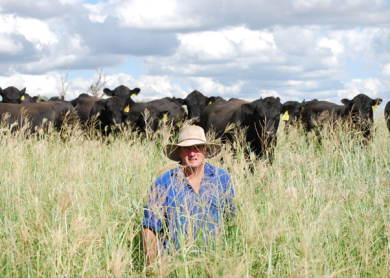
“Cattle are able to get to condition scores and weight so much quicker because the quality and volume of grass we have on the country we've improved is probably three to four times more productive than what it was naturally,” Ben explains.
“That's why we've been able to have this huge growth curve, due to the efficiency we're having on properties with the tropical grasses combined with our cropping country.”
Wendy says sub tropical grasses are important for the way they raise their bulls. “Pasture is paramount to the operation that we run,” she says. “Bulls are weaned onto crops and then they go straight onto sub tropicals and that's a very big part of how we try and get our rumens in the bulls functioning at one hundred percent.”
Ben credits expert advice received from Barenbrug Territory Manager Chris Collyer and Agronomist Marty Conroy-Jaeger for the significant improvement of problem areas.
“We've got a large variation of soil types here ranging from raw sand, loamy red soils, clay red soils, black soils, then some self-mulching sort of soil,” Ben explains.
“Both Marty and Chris have been excellent in advising us on different grasses for different areas and over the last 20 odd years, we've really noted which grasses suit which areas and how they perform".
The increase of production off that country since we've introduced those tropical grasses has been phenomenal.
The Maynes have been particularly impressed with the performance of the Megamax panic grass they first planted around 15 years ago. Wendy says it thrives on their black soil country and exceeded all expectations during the 2019 drought.
“It was a terrible time and this paddock was completely denuded of any sort of pasture and we thought we were going to have to replant everything, there was absolutely nothing there,” Wendy explains. “It really did look like you were walking on the moon.”
However when the drought broke, Wendy says that paddock came back with some of the thickest grass she’s ever seen.
“Persistence is when it can survive a prolonged, four year, worst drought in history. To come out of that and be able to bounce back and produce a paddock that was pure - it really did look like a crop,” she says.
“It was almost like an oat crop and the production we got off that - we had the bulls running on it and the daily weight gains and growth rates we got out of that Megamax was phenomenal,” Ben adds.
Last summer, they planted another 200 hectares of black soil to Megamax.
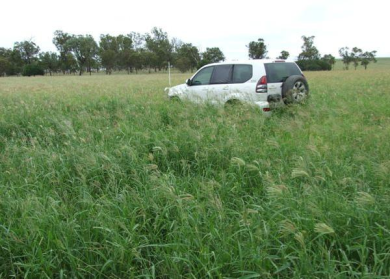
“Sometimes when you plant it, you have to look away for about two years because grasses can take a while to establish, but once they get established the production is amazing,” Wendy says.
For an operation which prides and promotes itself on growing out all of their sale bulls on sub tropical grasses, these high performing pastures are essential to the ongoing success of Texas Angus, from supporting high conception rates through to decreasing turnoff times.
“We’re known for high performance here in the Angus world and when you get cattle that are whacking on weight just off grass, it's really important for us,” Wendy says. “Fertility is a big driver in our program and if we have plenty of high production grasses there, it certainly helps in terms of improving fertility.
“We do a lot of carcass competitions too and these steers are all coming off the sub tropicals.”
Learn more
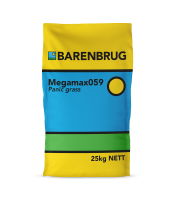
Megamax 059
-
Use pattern 5-20+ year tropical grass pasture systems
-
High quality feed production
-
Suits a wide range of soil types and conditions