
Annual vs. Italian Ryegrass: What’s the Difference?
Did you know that Annual and Italian ryegrass are the same species, but thrive in different conditions? Learn which variety best suits your climate and needs.
Annual and Italian ryegrasses are in fact the same species, Lolium multiflorum. Sometimes annuals may be referred to in literature, or on seed certificates, as Westerwolds ryegrasses, or Lolium westerwoldicum. Botanically, there is no difference.
In producer conversations, both groups of grasses are often referred to loosely as annuals and there is a fairly big overlap in their application in farm systems in Australia.
So, what’s the difference?
The origin of true annuals is found in regions such as northern Europe. The winters are icy, cold and dark and it’s impossible for ryegrass to grow. Instead, the ryegrasses germinate in the spring, grow and produce through the long, mild summer days and set seed in autumn. The flowering response and setting of seed is triggered through increasing daylength hours. They set seed in the early autumn and fall to the ground, harvested for seed or get included as a weed seed in grain crops, ready to be stored or wait until the following spring. Like cereals, the majority of annual ryegrass tillers will turn reproductive and set seed. Once a tiller has initiated flower formation, and whether it goes to maturity or is cut for silage or hay or grazed off, it will die. So, a true annual ryegrass has little prospect of coming back from harvesting once all or most of it has gone reproductive.
By contrast, Italian ryegrasses are selected from genetics that originate in areas around southern Europe. The winters are not so harsh and dark, offer an opportunity to grow with the winter rains, but the summers are typically hot and dry. These plants naturally set seed in late spring to early summer in order to put seed in the ground for the following autumn. The flowering and seed set response within true Italian ryegrasses is from accumulated periods of exposure to cold, also known as vernalisation. Note that Italian ryegrasses will continue to produce tillers after the vernalisation, which is what also adds to the later-season feed quality compared to annuals. Hence, if you have a mild summer area where ryegrass can survive through December to March, then Italian ryegrasses can reliably produce in the year following sowing. In some cases, producers in these areas will spring plant them, as they remain vegetative and offer nutritious feed through the summer.
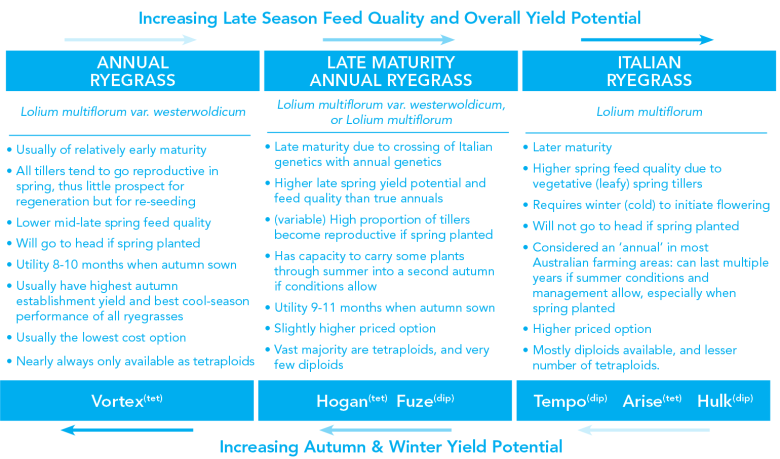
Can some annuals still go through for a second year?
Yes, they can, but there are a few things to bear in mind.
True annuals, the early to mid-maturity ones like Vortex, will not reliably come back after summer as they have basically expended all their tillers as reproductive seeds heads. The exception to this is if the pasture has been allowed to go to seed and volunteer for the next year.
Italians have the potential to come back if the spring vegetative tillers can survive the summer. Cooler temperatures, irrigation or rainfall, good fertility, and grazing management will help this. In the right environment, an Italians ryegrass can potentially behave like a perennial and last many years.
Plant breeding has utilised genetics from annuals and Italians and made crosses to gain some comparative benefits, such as retaining feed quality later into spring. A fine example of this in Hogan. Given a generous and long spring, good nutrition and careful management over summer, these late maturity annuals can offer some utility into the following year.
Be aware however, that what may look (on first glance) as a reasonable plant density following summer, may not be as productive as a newly sown pasture, particularly after the first grazing or two in autumn or early winter. It is very often the case that it is a false economy to retain an annual or Italian after the first year, unless conditions are perfect. In situations where seasonal performance akin to an annual or Italian is desired but for a reliable number of years, and summer conditions allow ryegrass survival, consider a hybrid ryegrass for such applications.
What about the Australian applications for these grasses?
From a simplistic perspective, a lot of southern Australia typically has two seasons: a green one and a brown one. This refers to the strongly mediterranean type climate in that we have a cool-season dominant rainfall pattern together with warm to hot and dry summers. In such areas, spring conditions tend to conclude briskly and the Australian summer kicks in early.
In coastal and southern-most areas such as parts of Gippsland or Tasmania, the spring tends to hold on a bit longer and the summers are not so hot and dry as a rule, by comparison to more inland and northern parts of the country.
Areas in coastal northern NSW, or coastal and elevated parts of Queensland, offer good growing conditions for ryegrasses too, but only in the cooler months. Summers tend to be too hot and humid for ryegrasses to survive, and other feed options fill the gap instead.
Where to use which annual or Italian ryegrass:
| Maximum winter feed, with an early spring finish: | Vortex annual ryegrass (mid maturity) |
| Summer will get hot, but the spring is usually a bit longer: | Hogan annual ryegrass (very late maturity) or Fuze annual ryegrass (late maturity) |
| Spring is long with a mild summer and/or irrigation: | Arise or Tempo Italian ryegrass (late maturity) Hulk Italian ryegrass (mid-late maturity) |
| Annual ryegrasses | Italian ryegrasses | |
|---|---|---|
| Productive life-span: | 8-10 months | 10-18 months |
| Relative cool season growth: | 5/5 | 4/5 |
| Relative late spring feed quality: | 2/4 | 3/4 |
| Relative cost of seed: | $$$$$$$$$$$$$$$ | $$$$$$$$$$$$$$$ |
| Used for: | Areas that have a shorter spring growing period (early-mid maturity annuals) or a longer spring but with a definite switch to hot summer conditions (later maturity annuals). | Longer Spring growth areas to maximise yield and feed quality deep into spring or early summer. Good prospects for two or three fodder harvests should conditions allow. Will respond to summer moisture and are sometimes retained for a second year in milder summer climates. |
Notes:
Productive life-span: indicated typical reliable period of utility when autumn sown. Variations will occur depending on sowing times, seasonal conditions and geography.
Relative cool season growth: indicative scale growth potential where an early-mid maturity annual with good modern genetics and well managed can achieve five out of five.
Relative late spring feed quality: relative scale out of five, where five equals feed quality during vegetative growth stage. As grasses mature and go reproductive, the proportion of stem increases, reducing energy levels, protein and increasing fibre thus limiting intake. Varietal selection through modern genetics, sowing later varieties, seasonal conditions, pasture management, harvest timing will all contributing to determining the potential feed quality of fodder production or late season grazing.
Relative cost of seed: seed price for quality options and utility is an investment. This $ relationship is roughly compared to the price of elite perennial ryegrass as a rating of fifteen $.
Varieties to consider:
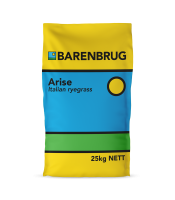
Arise
-
High forage yield
-
Quick establishment for early feed
-
Capable of multiple grazings
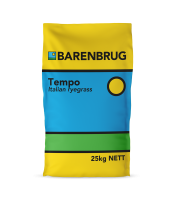
Tempo
-
Faster to establish than other Italian ryegrasses
-
Rapid establishment with good winter growth
-
Suitable for grazing, hay or silage
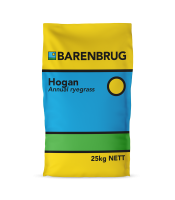
Hogan
-
Late season quality and re-growth
-
Very late maturing tetraploid annual ryegrass
-
Superior total forage yield in high rainfall areas
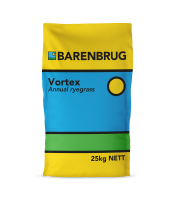
Vortex
-
Performs well in hot environments due to Australian selection pressures
-
Adaptable & reliable performance across a wide range of environments
-
Excellent establishment vigour